Repair or replace a Detroit concrete driveway?
Most cracks are cosmetic, a worn but sound slab takes a topping, and a settled one can often be lifted back to level for a fraction of a repour. Here is how to tell which one you have.
A referral service for Detroit homeowners. An automated assistant answers; calls are recorded.
Typical cost: $12 – $15 per square foot installed, plus $1 – $3 per square foot to remove the old slab (one Southeast Michigan concrete contractor's posted range, March 2026)
- Cost to call
- Nothing
- Answered by
- Automated assistant
- Hours
- Any hour
What you are looking at
Flaking and peeling — it has a name
Scaling is the flaking of the finished surface after freeze-thaw cycles, and moderate scaling exposes the stone and takes an eighth to three-eighths of an inch of the surface with it (the industry’s guide (PDF)).
De-icers make it worse by keeping the surface saturated and multiplying the number of freezes and thaws it goes through (same guide). A sound slab that is only scaled is a resurfacing candidate — one with heavy, spreading scaling may not be worth topping at all.
Cracks that start at the joints
Most cracks in a slab are cosmetic. Two kinds are not, and one of them is a freeze-thaw failure with a name: D-cracks, which start at joints at the bottom of an exterior slab and show up years later (the industry’s guide (PDF)).
That is a slab failing from the inside, not a surface problem, and a topping does not fix it.
A panel that has sunk
One panel lower than its neighbors is a base problem, not a concrete problem — and it can usually be lifted back to grade instead of broken out.
$600 to $2,000 to level a driveway, 25% to 50% less than replacing it, lasting five to ten years (national cost guide, August 2025).
One check you can make yourself
Look at the joints. The industry’s guide puts them a quarter to a third of the slab’s depth and 24 to 36 times its thickness apart — on a four-inch slab, a joint every eight to twelve feet, with panels roughly square (the guide (PDF)).
A slab with joints far wider than that, or panels much longer than they are wide, was built to crack. It is worth knowing before you buy the same thing again.
Forty-seven freezes and thaws a year, by federal count.
Federal weather data for the Detroit City station averages 47 freeze-thaw cycles a year, over a period of record of 1973 to 1996. the weather data (PDF)
The flaking is freeze-thaw, and de-icer multiplies it.
De-icers, in the industry’s own order
What to put on the concrete, and what never to, in the order the industry’s guide gives it.
- The first winter, don’t. Avoid de-icing chemicals on newly placed concrete and use clean sand for traction.
- After that, in moderate amounts. Rock salt (sodium chloride) and calcium chloride are the two the guide calls acceptable for concrete.
- Never ammonium sulfate, ammonium nitrate, or magnesium salts. The guide’s words: they are chemically aggressive and destroy concrete surfaces — read the bag.
- Magnesium arrives on your tires. It is used to treat roads before snow and gets tracked home onto driveways and garage slabs.
- Hose off the salt the cars bring home when the weather lets you.
- Fix the drainage. Poor drainage lets salt solutions stand on the surface, and that makes the exposure more severe. All of it is in the guide (PDF)
When repair stops making sense
The industry’s guide is blunt about the limit: repairing slabs with excessive and progressing scaling may not be feasible (the guide (PDF)). Cracking that starts at the joints and deepens with age is the other one that a surface fix does not reach (the cracking guide (PDF)).
Put simply: a sound slab that is worn takes a topping; a sound slab that has settled gets lifted; a slab that is broken through in several panels, draining the wrong way, or D-cracking gets taken out and repoured.
If the approach at the curb is part of what is failing, it is a separate job with a city permit and a six-inch spec — what the city requires.
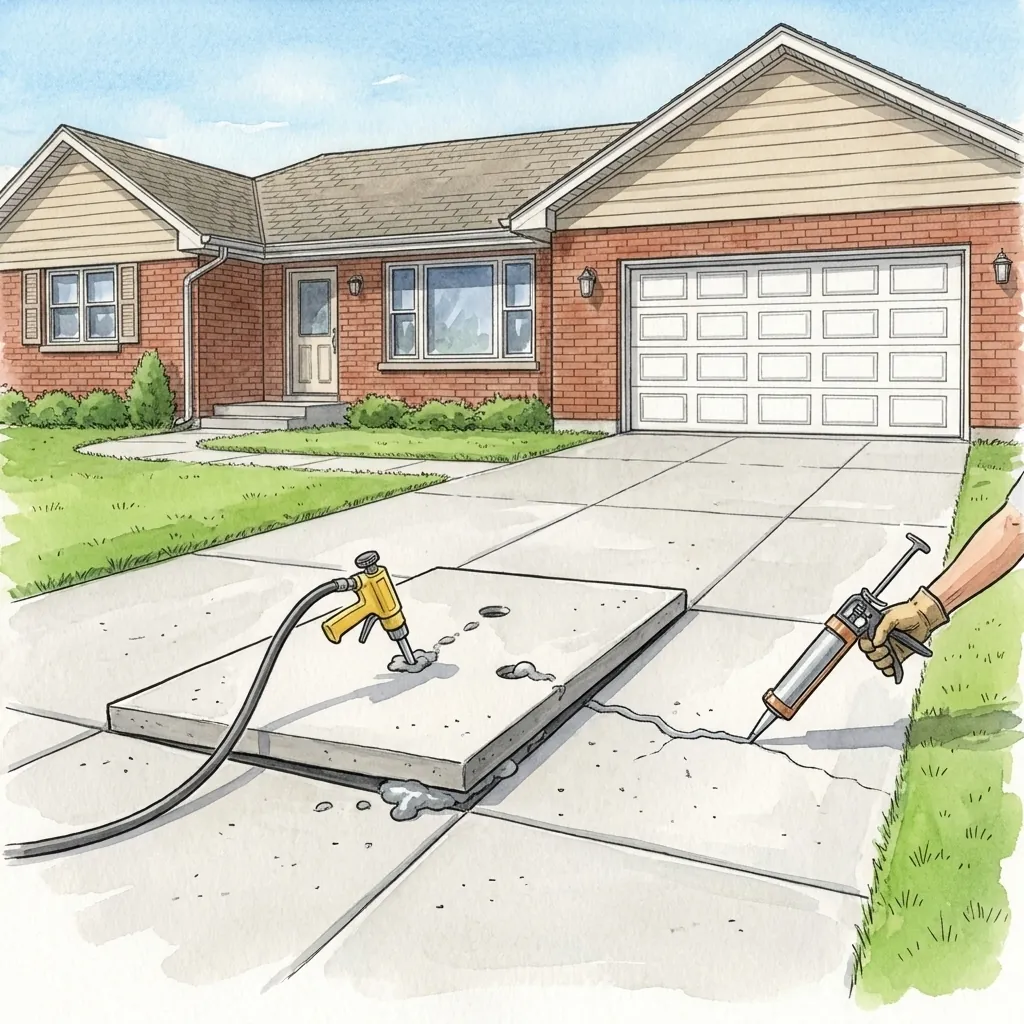
Repair, resurfacing and leveling ranges
One concrete contractor who serves Detroit looks at it and tells you which job it is.
These are national published ranges, not quotes. Every range on the site
Questions
Checked September 17, 2026
Is a crack in my driveway serious?
- Most cracks are cosmetic. The two the industry’s guide says are not include the ones that start at the joints from freeze-thaw and appear at later ages (the guide (PDF)).
Can a sunken section be lifted instead of replaced?
- Usually, when the slab itself is sound: leveling a driveway runs $600 to $2,000, which is 25% to 50% less than replacing it, and it lasts five to ten years (national cost guide). Leveling with polyurethane foam runs $5 to $25 per square foot.
Is resurfacing worth it?
- Over a slab that is worn but sound and still draining, yes — $3 to $10 per square foot against $12 to $15 to replace (resurfacing, replacement). Over one with heavy, spreading flaking the guide says the repair may not be feasible (the guide (PDF)).
What salt is safe on concrete?
- None the first winter — use clean sand. After that the guide calls rock salt and calcium chloride acceptable in moderate amounts, and says ammonium and magnesium de-icers destroy concrete surfaces (the guide (PDF)).
Will I be charged for the visit?
- Calling us costs nothing. Some contractors charge to come out and measure. Ask before they come, and get the price in writing.