Detroit driveway permits and licenses: who pulls what, and who to call
The slab on your lot and the concrete at the curb are governed by different rules, and the license behind the work is the state’s. Every line here links the page it came from.
A referral service for Detroit homeowners. An automated assistant answers; calls are recorded.
Typical cost: $12 – $15 per square foot installed, plus $1 – $3 per square foot to remove the old slab (one Southeast Michigan concrete contractor's posted range, March 2026)
- Cost to call
- Nothing
- Answered by
- Automated assistant
- Hours
- Any hour
The city’s permit
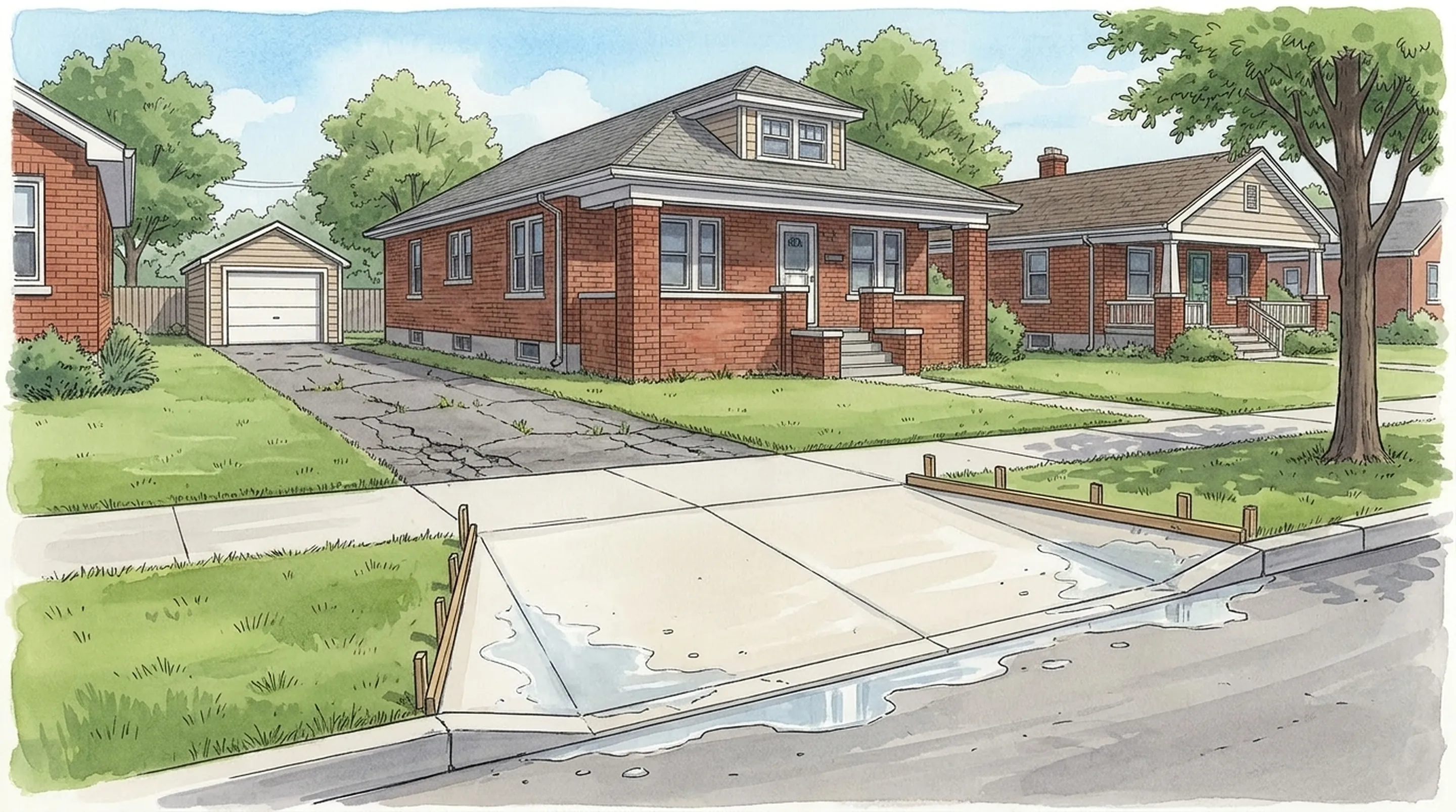
The rule is one sentence: no sidewalk or driveway may be laid in a street, alley or other public place in the city without a permit from the head of the public works department. The same section lets a property owner be granted one for their own property, on the condition that they are competent to build and maintain it and will follow the city’s specifications (the code).
- The permit types, by the city’s own names: Drive Approach, Remove and Replace · Curb Cut · Sidewalk Replacement (Contractor or Professional) · Sidewalk Replacement (Homeowner’s) (the city’s permit page).
- Plans first. The city reviews drawings before it issues the permit, and they must be signed and sealed by a licensed architect or engineer, with a letter describing the work and its dates (the permit page).
- A $2,500 bond, and five years. Anyone in the business of laying sidewalks or driveways here posts it with the city, conditioned on keeping the work in good repair for five years (the code) — and the department says the bond has to be in place before any work starts in its ground (the permit page).
- A stamp before the pour. The contractor’s name and the year go into the end slab, and the inspector has to be shown the stamp on site before concrete is placed (the permit page).
- Where a new driveway may go: at least 40 feet back from an unsignalized intersection, with the walking path level across it (the city’s curb cut specification (PDF)).
- Who to call: for a house, the permit office at 2 Woodward Avenue, Suite 642 — (313) 224‑3924; the buildings and engineering department’s (313) 224‑3173 is the listing for new developments (the city’s driveway approach page). General questions: (313) 224‑3935 (the permit page).
The permit fee is not published
Detroit publishes no fee for a drive approach permit, a curb cut, or a homeowner’s sidewalk permit.
The city’s own answer is to call the permit office at (313) 224‑3935 (the permit page). Ask your contractor for the permit and its cost in writing, as a line of its own.
Whether the slab behind your sidewalk needs a city permit at all is also unpublished. The city’s permit guide lists the driveway approach and the sidewalk flags around it — the parts in its own ground — and says nothing either way about a driveway on private property (the guide (PDF)). Ask the city’s building department before the pour.
The license behind the work
- Michigan licenses concrete as its own craft. The state’s contractor license names the trades it covers — concrete and masonry among them — and the license record says which ones (the law, the state’s license information).
- The threshold is $600. The state tells homeowners plainly that any contractor offering work totaling $600 or more in labor and materials must be licensed (the state’s homeowner page) — which is every driveway job.
- Ask about the city side too. Detroit’s building department issues and renews its own building licenses, and says they are required to perform work in the city (the city’s license page). Concrete is not one of the trades it examines, so the state license is the one that names this craft — ask for both.
- “Licensed and insured” on a website is not the same as a concrete classification. The license record names the trades; the state’s license lookup shows it, and it takes a minute.
- Insurance is not checkable. Michigan publishes no register of a contractor’s insurance, so nobody — us included — can verify it from a public source. Ask for the certificate and call the agent on it.
An unlicensed contractor cannot sue you, or lien your house.
State law says a contractor working without the license it requires cannot bring an action to collect payment, and cannot place a lien on the property. the law · the state’s license lookup
Check the license before the work, not after.
If the city writes to you
When a sidewalk or driveway is out of repair, the city gives the owner 30 days’ notice to repair it (the code). If it is not done in that window, the city may do the work and charge the cost to the owner (the code).
And if someone is hurt on it after a notice and the city pays damages, the code says the owner is liable to the city for what it paid. One sentence, and it is the reason the 30 days is worth taking seriously.
If your driveway meets a state road
Roads with an M, US or I number are the state’s, not the city’s. The state’s own answer: if you are upgrading a driveway or building a new one onto one of them, a driveway permit from the state may be all that is necessary — and it warns that a driveway built without one may be removed, or referred to the state attorney general (the state transportation department).
The application takes a drawing with the location, dimensions and surface, and drainage has to be addressed before the permit issues. For a residential driveway permit the state requires no bond, and there is a fee, set when the application is received.
Which streets are city, county or state is published as a map (the city’s road jurisdiction map (PDF)).
What the city’s permit record shows
Detroit publishes its permits for work in city ground as open data. Over the period the file covers — permits issued from March 2021 to January 2025 — drive approach and curb cut permits number in the dozens, and sidewalk permits in the hundreds, with about eleven times as many sidewalk permits pulled by contractors as by homeowners (the city’s open data).
Questions
Checked September 17, 2026
Who pulls the permit, me or the contractor?
- Usually the contractor. Anyone in the business of laying driveways here must already hold a $2,500 bond with the city, so ask whether they do (the code) — and the code also lets an owner be granted a permit for their own property if they will build and maintain it to the city’s specifications (the code).
Do I need a permit for a driveway on my own lot?
- The city publishes an answer only for the part in its own ground — the approach and the sidewalk flags around it (the permit guide (PDF)). For the slab behind your sidewalk, ask the city’s building department before the pour.
How do I check a contractor’s license?
- Search the name at the state’s license lookup; the record shows the license type and the trades it covers. In Detroit, ask whether they also hold the city’s own building license, which the city says is required to work here (the city’s license page).
What happens if the work is done without a permit?
- For work in the city’s ground the permit is required by code before any driveway is laid in a street, alley or public place (the code). On a state road the state says a driveway built without its permit may be removed (the state transportation department).
Will I be charged for the visit?
- Calling us costs nothing. Some contractors charge to come out and measure. Ask before they come, and get the price in writing.