Concrete driveway replacement in Detroit
A repour is one day of concrete and a week of waiting, and almost everything that decides how long it lasts is settled before the truck arrives — in the ground under it, in the mix, and in where the joints go.
A referral service for Detroit homeowners. An automated assistant answers; calls are recorded.
Typical cost: $12 – $15 per square foot installed, plus $1 – $3 per square foot to remove the old slab (one Southeast Michigan concrete contractor's posted range, March 2026)
- Cost to call
- Nothing
- Answered by
- Automated assistant
- Hours
- Any hour
Five lines to put in the written quote
All five come from the concrete industry’s own technical guides. They cost nothing to ask for and they make two bids comparable.
- 4,000 psi. The guide’s number for an exterior slab that will see de-icers; 3,500 where it will not (the guide (PDF)).
- Air-entrained, about 6 percent total air for the usual ¾-inch or 1-inch stone (same guide).
- Broom finish. “For most exterior surfaces a broom finish is adequate” — and it is what the city’s own approach detail expects at the curb (the guide (PDF)).
- Joints cut a quarter to a third of the slab’s depth, spaced 24 to 36 times its thickness — on a four-inch slab that is a joint every eight to twelve feet, with panels roughly square and no longer than about one and a half times their width (the guide (PDF)).
- Base: topsoil and soft spots out, then compacted. “The soil beneath the slab should be compacted soil or granular fill, well compacted by rolling, vibrating or tamping” (same guide).
One more, on the day: no extra water in the truck at the job. The guide puts too much water in the mix third on its own list of why slabs crack.
The ground decides more than the concrete
The industry’s list of what makes slabs crack starts, in its own order, with the joints, then the ground underneath — missing or badly placed joints first, improper subgrade preparation second, then too much water in the mix, then finishing, then drying out too fast (the guide (PDF)). The concrete is fourth or fifth on its own list of failures.
That is why a bid that prices the base separately is telling you something, and why “we’ll pour right over it” is a different job with a different life. A slab that is sound and only worn does not need tearing out at all — a topping is $3 to $10 per square foot.
Frost is a footing question, not a driveway question. Federal weather data for Detroit puts the fifty-year frost depth at 61 inches (the data (PDF)). A driveway slab is not built down to that. It sits above the frost line and moves with it, which is what the joints and the air in the mix are there for.
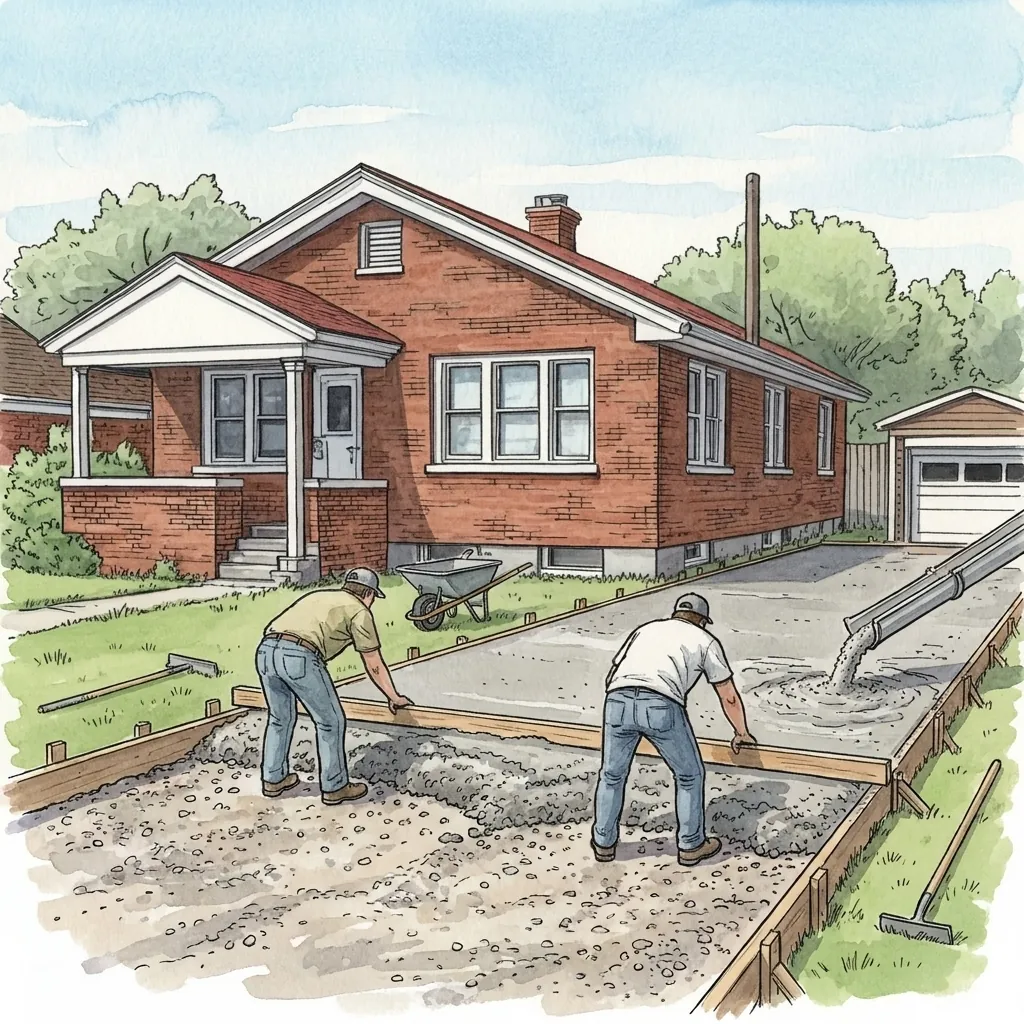
Curing, and when you can drive on it
Three to seven days of keeping it wet, at above 50 °F, and concrete left to dry out can lose as much as half the strength it would have had (the industry’s guide (PDF)).
The city says the same thing to residents in plainer words after it replaces a sidewalk: “it may take up to 7 days for the concrete to cure or get hard enough to drive across it”, and it warns that marking or damaging new work in that window can leave you paying for the replacement (the city’s sidewalk page).
- Don’t de-ice it the first winter. Use clean sand for traction; de-icers come later and in moderate amounts (the guide (PDF)).
- Watch the season. The guide warns against exterior concrete placed in late fall, winter or early spring where it can freeze while still saturated, and a winter pour costs 15% to 25% more anyway (the contractor’s price list).
What Detroit counts as a driveway
- One per house. The zoning code allows not more than one driveway per residential dwelling unit, with narrow exceptions (the city’s driveway approach page).
- Gravel is not a driveway. The code requires a solid paved access to the garage or parking area and rules out gravel, slag and cinder; the city’s own page paraphrases it as “constructed of concrete, asphalt or solid pavers” (the city’s page).
- It matters at the curb. The city says that when it replaces damaged sidewalks and there is no paved driveway behind the approach, the approach is removed and replaced with curb (the city’s page).
- On a paved street the approach must be concrete from the curb to your lot line, at a grade the city sets; asphalt is allowed there only on an unpaved street (the city’s code).
Detroit holds your contractor to five years.
Anyone in the business of laying driveways here posts a $2,500 bond with the city, conditioned on keeping the work in good repair for five years. the bond in the city’s code · the city’s permit page
Ask whether they are bonded with the city. It is a yes or no question.
Replacement ranges
- Driveway, Detroit, unreinforced
- $6 – $12 per sq ft
- Detroit vendor page, June 2024 — over two years old
Sizes are the contractor’s own examples, before removal. Every range on the site, and what moves each one
Questions
Checked September 17, 2026
How thick should a Detroit driveway be?
- Four inches is the usual residential slab, and six is what a national guide recommends where heavy vehicles park (the guide). At the curb it is not a choice: the city’s own drawing calls for six inches on a residential approach (the drawing (PDF)).
Do I need rebar or wire?
- No published source makes it mandatory for a residential drive, and a national guide prices it at $1 to $3 per square foot as an option that improves crack resistance in freeze-thaw climates (the guide). Joints, base and air content come first on the industry’s own list of what prevents cracking (the guide (PDF)).
Can they pour over my old driveway?
- A bonded topping is a real option when the slab underneath is sound, worn rather than broken, and still draining (what resurfacing costs). Over a slab with heavy, spreading flaking the industry’s guide says repair may not be feasible (the guide (PDF)).
How long does the job take?
- It depends on the size and how much comes out, so ask the contractor who measures for the schedule in writing. The one published number is the wait after the pour: up to seven days before you drive across it (the city’s sidewalk page).
Will I be charged for the visit?
- Calling us costs nothing. Some contractors charge to come out and measure. Ask before they come, and get the price in writing.