Your driveway approach and sidewalk in Detroit: who owns what
The strip from your sidewalk out to the street — the walk, the grass and the curb — is ground the city controls. You still maintain the concrete on it, and the city writes the spec for how it is built.
A referral service for Detroit homeowners. An automated assistant answers; calls are recorded.
Typical cost: $12 – $15 per square foot installed, plus $1 – $3 per square foot to remove the old slab (one Southeast Michigan concrete contractor's posted range, March 2026)
- Cost to call
- Nothing
- Answered by
- Automated assistant
- Hours
- Any hour
Start with the city’s own sentence
“To repair a sidewalk or drive approach, you can hire a contractor or elect to do the work yourself. In either case, make sure the necessary permits are obtained.” — the city’s sidewalk page
That is the whole job of this page: what the permits are, who pulls them, what the city requires the concrete to be, and what it can do if the work is not done.
Two jobs, two owners
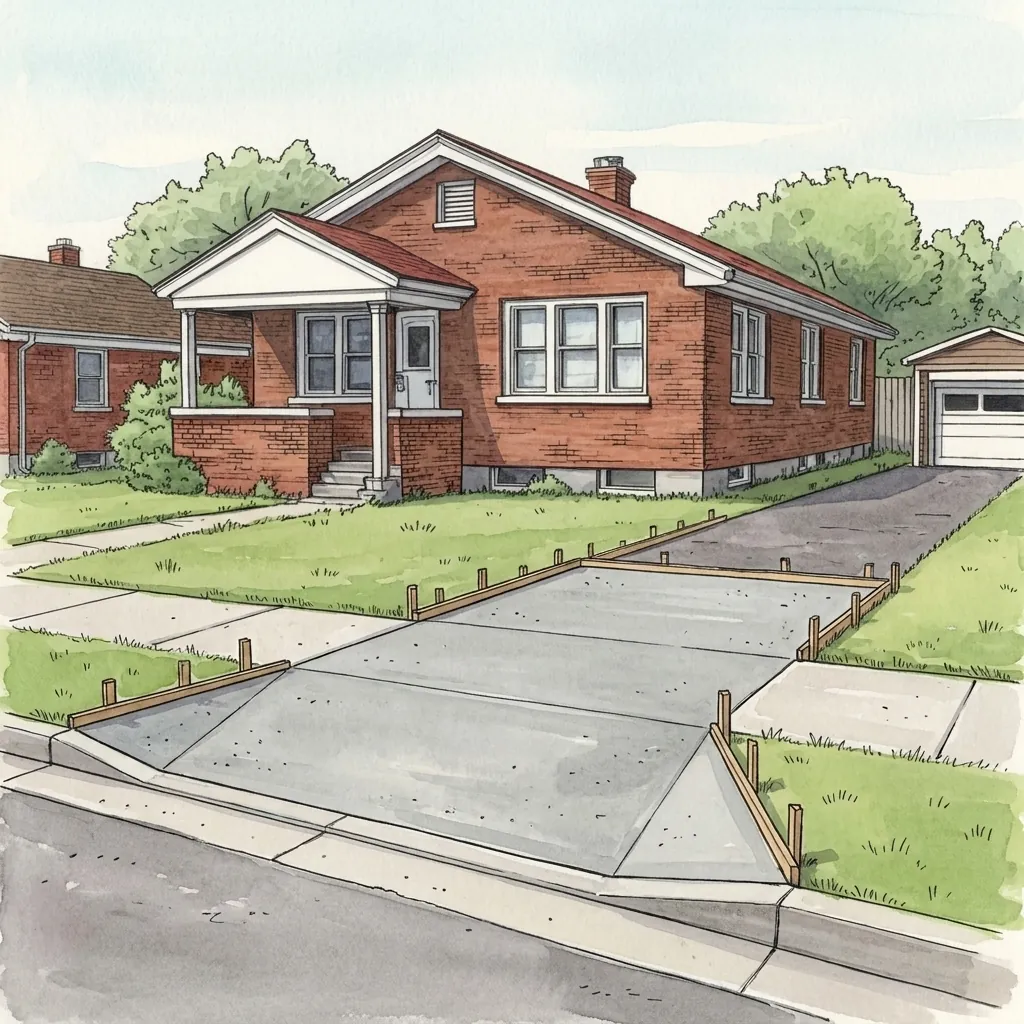
The driveway on your lot is private work. The approach — the concrete crossing the sidewalk and the grass strip out to the curb — sits in ground the city controls: the street, the alley, the public sidewalk, the curb and the strip between curb and walk (the city’s permit page).
Controlling the ground is not the same as maintaining what is on it. The city is plain about that: “Like the sidewalks, the property owner is responsible for maintaining the driveway approach. The City may repair it, if it is damaged by a City tree.” There are over 4,200 miles of sidewalk in Detroit and the owner keeps the piece in front of their house in good repair (the city’s sidewalk page).
On a paved street the approach has to be concrete from the curb to your lot line, at a grade the city sets. Asphalt is allowed out there only on an unpaved street (the city’s code).
The permit, and who to call
The city’s code is one sentence long about it: no sidewalk or driveway may be laid in a street, alley or other public place in the city without a permit from the head of the public works department — and a property owner may be granted one for their own property, on the condition that they are competent to do the work, maintain it afterward, and follow the city’s specifications (the code).
The department names a permit type for exactly this job. Its list includes Drive Approach, Remove and Replace, Curb Cut, Sidewalk Replacement (Contractor or Professional) and Sidewalk Replacement (Homeowner’s) (the city’s permit page).
- New developments or redevelopment: the city’s buildings and engineering department, 4th floor, 2 Woodward Avenue — (313) 224‑3173.
- Residential and commercial properties, curb cuts only: the public works permit office, 2 Woodward Avenue, Suite 642 — (313) 224‑3924. Both listings are on the city’s driveway approach page
- A house is the second one. The first number is for new construction; a driveway or a curb cut at an existing home goes to the permit office in Suite 642.
- General questions about work in the city’s ground: the city’s permit office at (313) 224‑3935 (the city’s permit page).
What the city’s own drawing requires
The city publishes a standard sheet for a drive approach. These are its numbers, and they are why the approach is priced apart from the driveway behind it.
- Six inches of concrete on a residential approach — eight on a commercial one — against the four inches a driveway is normally poured at.
- A 7-foot minimum and 9-foot maximum opening at the property line, with a 10-foot standard curb cut unless the city’s engineer approves otherwise.
- 1-inch expansion joints at the property line, at the sidewalk and at the back of the curb, with the top edge finished to a quarter-inch radius.
- The ramp at 8.33% maximum, and the sidewalk across it 6 feet clear at 2% maximum cross slope — the federal accessibility rules, which the city applies to replaced walks.
- The sidewalk flags beside the approach get replaced where that is what it takes to make a smooth transition and hold the 2% cross slope. All of it is in the city’s standards sheet (PDF)
- Set a new residential driveway at least 40 feet back from an unsignalized intersection, and keep the walking path level and continuous across it (the city’s curb cut specification (PDF)).
Before the permit, and before the pour
- A drawing, reviewed. The city reviews plans before it issues the permit, and the submission needs a letter describing the work, with start and finish dates, plus drawings showing location, dimensions, the surface being disturbed, the proposed grades and slopes, and how the area will be restored. The drawings have to be signed and sealed by a licensed architect or engineer (the city’s permit page).
- A bond, held for five years. Anyone in the business of laying sidewalks or driveways in Detroit posts a $2,500 surety bond with the city, conditioned on keeping the work in good condition and fit for public travel for five years from completion — and a homeowner hurt by inferior material inside those five years can recover on that bond (the city’s code). The department states it plainly too: the bond must be in place before any work is done in the city’s ground (the permit page).
- A stamp, before the concrete goes in. Every approach a contractor pours here carries the contractor’s name and the year pressed into the end slab, in a mark about 4 by 6 inches — and no concrete may be placed without the inspector being shown the stamp on site (the permit page). Look at the end of your existing approach; it may tell you who poured it and when.
If a city tree lifted it, the city may replace it free.
Report it and an inspector assesses the damage within 60 days, though the city says outright that it cannot give a date for the repair itself. the city’s sidewalk page
The city’s own advice: if you need it fixed soon, you may want to do it yourself.
If the sidewalk goes with it
A replaced walk has to come back 6 feet clear at 2% cross slope, and the flags beside a new approach usually go with it for the transition (the city’s standards (PDF), the city’s sidewalk page). Nationally, removing and replacing sidewalk runs $10 to $25+ per square foot (national cost guide, April 2026).
When the city’s own crews replace a walk it tells residents to stay off it for up to seven days, and that restoration of the grass follows within about four weeks — seed, not sod, and the resident waters it (the city’s sidewalk page).
Questions
Checked September 17, 2026
Who owns the approach — me or the city?
- The ground is the city’s and the maintenance is yours: the city says the property owner is responsible for maintaining the driveway approach, and that the city may repair it if a city tree damaged it (the city’s sidewalk page).
Can I pull the permit myself?
- The code allows an owner a permit for their own property, on the condition that they are competent to do the work, maintain it afterward and follow the city’s specifications (the code). The city also lists a homeowner’s sidewalk replacement permit as its own type (the permit page).
What does the approach permit cost?
- The city publishes no fee for a drive approach, curb cut or homeowner sidewalk permit. Its own answer is a call to the permit office at (313) 224‑3935 (the permit page) — ask your contractor for the permit and its cost in writing.
How many of these permits does the city actually issue?
- In the city’s own published permit record for March 2021 to January 2025, drive approach and curb cut permits number in the dozens and sidewalk permits in the hundreds (the city’s open data). Eleven times as many sidewalk permits were pulled by contractors as by homeowners.
Does the city ever remove an approach?
- Yes: the city says that when it replaces damaged sidewalks and finds no paved driveway behind the approach, the approach is removed and replaced with curb (the city’s driveway approach page).
Will I be charged for the visit?
- Calling us costs nothing. Some contractors charge to come out and measure. Ask before they come, and get the price in writing.